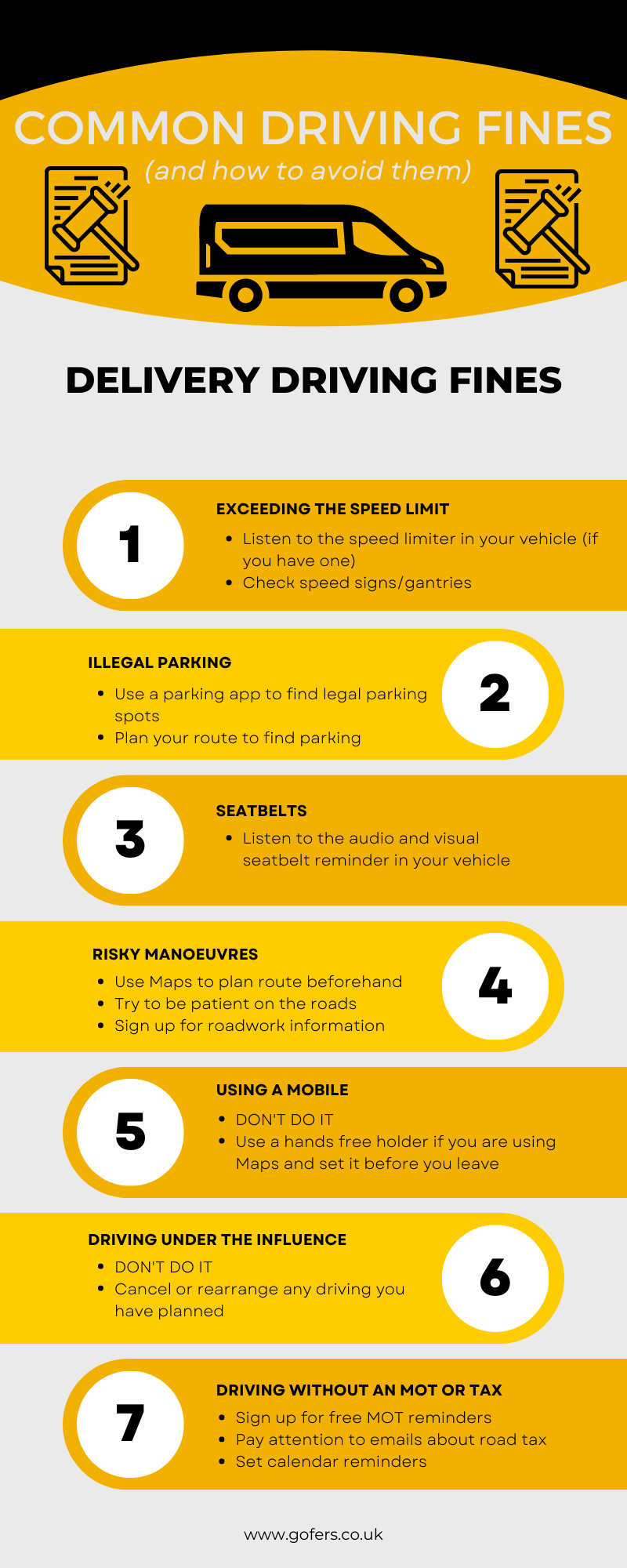
The most common fines for delivery drivers (and how to avoid them) – including recommendations for parking apps, how to sign up for free reminders and more

Having items delivered late can be a costly business – both for the end receiver who cannot complete their transaction, and also for the delivery company liable for the failure
There are many options available for sending documents, but a dedicated courier is by far the most reliable and safe option.
Late deliveries can be a big problem if you don’t take steps to resolve the issues and try to sort out the underlying issues
According to a recent study from the RAC (Report on Motoring 2020), nearly a third (29%) of all drivers make and receive calls on portable mobile devices. Policymakers are considering outlawing mobile phone use while driving as a result of evidence showing it increases the danger of being involved in a car accident. While limits would lessen property damage, accidents, and fatalities, consumers would no longer be able to use these devices conveniently while driving.
In this article, we’ll discuss how the current mobile phone laws impact business drivers, and what steps can be taken to ensure a business can still operate effectively.
The penalties for using a hand-held device while driving has changed since the law’s original enactment in December 2003, growing more severe, especially when the then Prime Minister Theresa May promised in 2017 to make the contentious subject as socially unacceptable as drink driving.
As of March 1, 2017, new drivers (“new” being those who have had their licences for less than two years) face the possibility of having their licences completely revoked if they are caught using a hand-held device. The fixed penalty notice for using a hand-held device while driving has doubled to £200 in addition to receiving six penalty points.
It is crucial to recognise and consider that it is illegal for someone (such as a manager or business owner) to “cause or permit” a driver to use a hand-held mobile phone while operating a motor vehicle. Therefore, if an employer permits the use of a hand-held phone while driving, both the employer and the employee may be held accountable.
Additionally, if an employee is caught, the financial impact on your company could be far greater than £200, with penalty fines of up to £2000 possible, depending on the extent of the incident.
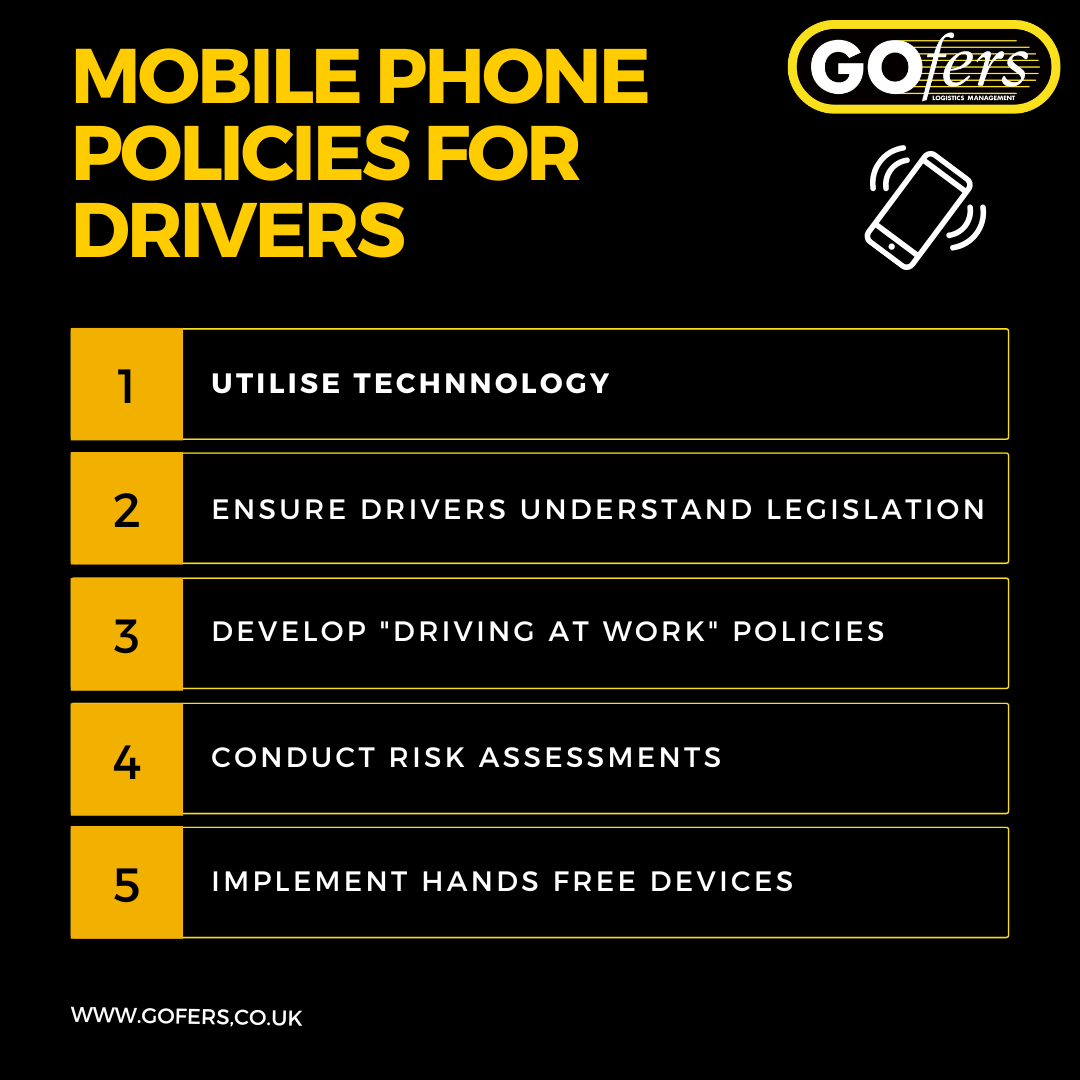
To ensure your business can still operate effectively alongside current and future mobile phone laws, you should abide by these steps:
Mobile phone use while driving remains an issue despite the recent changes to the law, which is why the Department of Transport (DfT) has long thought about introducing new technology to block mobile phone signals for drivers. The software would disable all functions on mobile devices that need an internet connection or a phone network connection, therefore rendering them worthless. Of course, this could lead to some major problems if a driver was to be in a crash and be unable to use their phone to call for help, hence why in part this has not yet been implemented.
With this in mind, it is crucial to promote the use of “Do Not Disturb” function on phones for all drivers, as well as Driving Mode, both of which effectively stop drivers using the phone when behind the wheel, but still allow for emergency calls if needed.
You can lessen the possibility of a penalty by making sure your personnel are aware of the guidelines and what is expected of them. Unfortunately, a lot of drivers don’t know about the most recent laws around mobile phone usage, and believe that using a phone while stopped at a traffic light or in traffic is allowed.
Typically, an organisation where employees have to drive as part of their role should expect everyone in this capacity to drive safely for their own benefit and the benefit of others. This expectation should be understood by all workers, including senior managers and line managers. It should be clearly stated to employees that they cannot drive and use their phones.
Additionally, it’s crucial to make sure line managers are aware of the fact that they cannot expect their drivers to respond to calls or messages sent to them while they are on the road.
You can create your own “Driving at Work” policy, either as a stand-alone policy or as part of a larger “Driving for Work” policy and adjust it to meet the needs of your organisation. Ensure that the policy expressly prohibits anyone operating a mobile phone or other similar devices while driving, including in a company vehicle, their own vehicle, or a hired vehicle, from placing or receiving calls, sending or reading texts or emails, taking, sending, or viewing photos or videos, using apps, or browsing the internet.
Encourage drivers and their bosses to put their phones on voicemail, access messages during breaks, and only react to them then. To prevent the driver from being tempted to turn on or answer a ringing phone, phones should ideally be turned off and placed out of reach (such as in the glove compartment).
Health and safety law applies to on-the-road job activities, and hazards should be adequately controlled within a health and safety system, according to HSE’s “Driving at Work” Guidelines. Employers must therefore perform appropriate risk assessments and make sure that:
You can reduce the likelihood that your personnel will violate the legislation against using a mobile phone while driving by adopting helpful measures to guide them and restrict the likelihood of mobile phone use. It could be beneficial to offer the following hands-free gadgets:
How does our courier service differ from what people call “parcel companies”, and what should you expect from each courier model?
It is really important that SMEs & businesses are offered an efficient, quick, and secure service to meet the demanding needs of their customers
With all of the choice for courier and post services, what sets a dedicated courier service apart from a traditional mail company?
We’ve always been proud of our fast and reliable courier service, and as the years have gone by, the sectors we work with have expanded greatly. From initially couriering to one or two B2B industries, we now handle a huge range of items for companies in construction, engineering, legal, retail, manufacturing, catering, signage, local government, services and many more.
With this versatility comes the continual need to be 100% reliable, and that’s what we always strive to be. With direct deliveries guaranteed and delivery notifications always available, we know we can meet the needs of our customers.
With the varied range of sectors we work in, we do find ourselves handling an often eclectic range of items. This can include:
It is very important to us that no matter what we find being booked in, each and every item is treated with the utmost care and respect from start to finish!
For a lot of our bookings, timing is very important – for example, if a legal document doesn’t arrive by the time it needs to be completed, it could mean that people waiting to complete a transaction won’t be able to do so. This can affect court proceedings, house purchases and many other transactions where legal documentation is binding.
Another such example would be if a car part did not arrive by courier on time – the vehicle may not then be ready for the customer in time.
This is why same day delivery services are so important and indeed, make up the core of our courier service. Available 24/7 with guaranteed direct routes from A to B, we make sure that anything that needs to be delivered on the same day is delivered as it needs to be! We also have a no minimum spend policy and 30 day credit facility for business customers.
More info on our Same Day Delivery service: https://staging.gofers.co.uk/services/same-day-delivery/