was successfully added to your cart.

Cart

Get an Instant Quote

Will 5G boost retail sales more than 4G?

By | Logistics Industry, News, Technology | No Comments

In 2013 we wrote about an eBay study that the arrival of 4G in the UK would boost the retail economy by around £1.8bn per year. 10 years on, and the arrival of 5G, have we seen this prediction come true?

2023 update

Move over 4G, 5G is here. Despite a mixed reception, 5G is being rolled out across the UK, with EE heading up the move to make the superfast wireless technology available in every town and city across the country. With the advent of 5G, and the majority of the UK still able to access 4G, have we seen a boost in retail?

It is certainly true that 4G opened up new avenues of “shopping on the go” for mobile users, as the previous 3G technology was often unable to load web pages that were necessary for online shopping. For years, many of us have relied on 4G technology to keep us connected and able to access websites, apps and services wherever we are, and 5G is the next step on this journey. However, it doesn’t seem that the coming of 5G will introduce the same sort of retail boost that 4G did, as most of us do already have sufficient access to shop online when we want to, wherever we are.

That isn’t to say that 5G won’t bring benefits to online consumers – increased speeds, richer customer experiences and less concern about losing signal are all benefits of using the 5G network. However, it is unlikely that retail will see the same level of boosted activity as when 4G became widely available from the introduction of 5G alone – especially as the current EE plan to cover all of the UK with 5G won’t be complete until 2028!

Since the COVID-19 pandemic lockdowns, online shopping has been on the rise and despite the full lifting of restrictions and vaccination programme in the UK, many have not returned to shopping in-store. This in itself has contributed massively to increased shopping online as well as the shift to flexible remote working which means that many use their home Wi-Fi networks more than ever, and do not rely in the same way on wireless internet in the way they did in 2013/2014.

Source: https://newsroom.bt.com/ee-to-offer-5g-solutions-across-the-entire-uk-as-bt-group-unveil-new-mobile-and-convergence-ambitions/

2013 post

4G ‘to bring £1.8bn retail boost’

A new study by eBay is predicting that the arrival of universal 4G in the UK could boost the retail economy by around £1.8 billion over a year. The boost represents a 113% year on year uplift in mobile shopping compared to 2012.

The study of over 2,000 UK consumers found that the opportunity is being driven by changing consumer behaviour, with 55% of consumers using their devices more for shopping now than this time last year. While the research found that just under a third of all UK adults use a smartphone for some aspect of their shopping journey, around one in ten use a smartphone for making purchases.

The study, compiled for the online marketplace by retail analysts Conlumino, reveals that the major frustrations for UK mobile shoppers are speed (50.3%) and reliability (49.6%). With the arrival of universal 4G predicted to help to break down barriers and increase consumers’ likelihood to shop via their smartphones or tablets, Ebay is calling on retailers to get their businesses 4G ready.

“Consumers today want convenience and speed. The arrival of universal 4G will bring with it a more immersive, instant and intimate shopping experience than ever before – putting the most exciting features of mobile retail as we know it into high definition. It won’t just turbo-charge the way we shop. It will truly give us the ability to shop anytime, anywhere. That means an extra £1.8 billion of consumer spending up for grabs. Retailers must act now and think about the virtual shop window, to turn this huge opportunity into an exciting reality.”

Olivier RoparsSenior director of m-commerce, Ebay Europe

“Retailers today must take every chance to engage consumers, inspiring them and giving them every possible opportunity to buy and interact with their brands. An omni-channel approach is key to making this happen and with universal 4G on the horizon, retailers can’t afford to stand still.”

Neil SaundersDirector, Conlumino
Gofers mobile phone laws

Mobile Phone Laws for Business Drivers

By | Delivery Services, Logistics Industry, Technology | No Comments

According to a recent study from the RAC (Report on Motoring 2020), nearly a third (29%) of all drivers make and receive calls on portable mobile devices. Policymakers are considering outlawing mobile phone use while driving as a result of evidence showing it increases the danger of being involved in a car accident. While limits would lessen property damage, accidents, and fatalities, consumers would no longer be able to use these devices conveniently while driving.

In this article, we’ll discuss how the current mobile phone laws impact business drivers, and what steps can be taken to ensure a business can still operate effectively.

How Do Current Mobile Phone Laws Impact Business Drivers?

The penalties for using a hand-held device while driving has changed since the law’s original enactment in December 2003, growing more severe, especially when the then Prime Minister Theresa May promised in 2017 to make the contentious subject as socially unacceptable as drink  driving.

As of March 1, 2017, new drivers (“new” being those who have had their licences for less than two years) face the possibility of having their licences completely revoked if they are caught using a hand-held device. The fixed penalty notice for using a hand-held device while driving has doubled to £200 in addition to receiving six penalty points.

It is crucial to recognise and consider that it is illegal for someone (such as a manager or business owner) to “cause or permit” a driver to use a hand-held mobile phone while operating a motor vehicle. Therefore, if an employer permits the use of a hand-held phone while driving, both the employer and the employee may be held accountable.

Additionally, if an employee is caught, the financial impact on your company could be far greater than £200, with penalty fines of up to £2000 possible, depending on the extent of the incident.

Steps to Ensure Your Business Can Still Operate Effectively

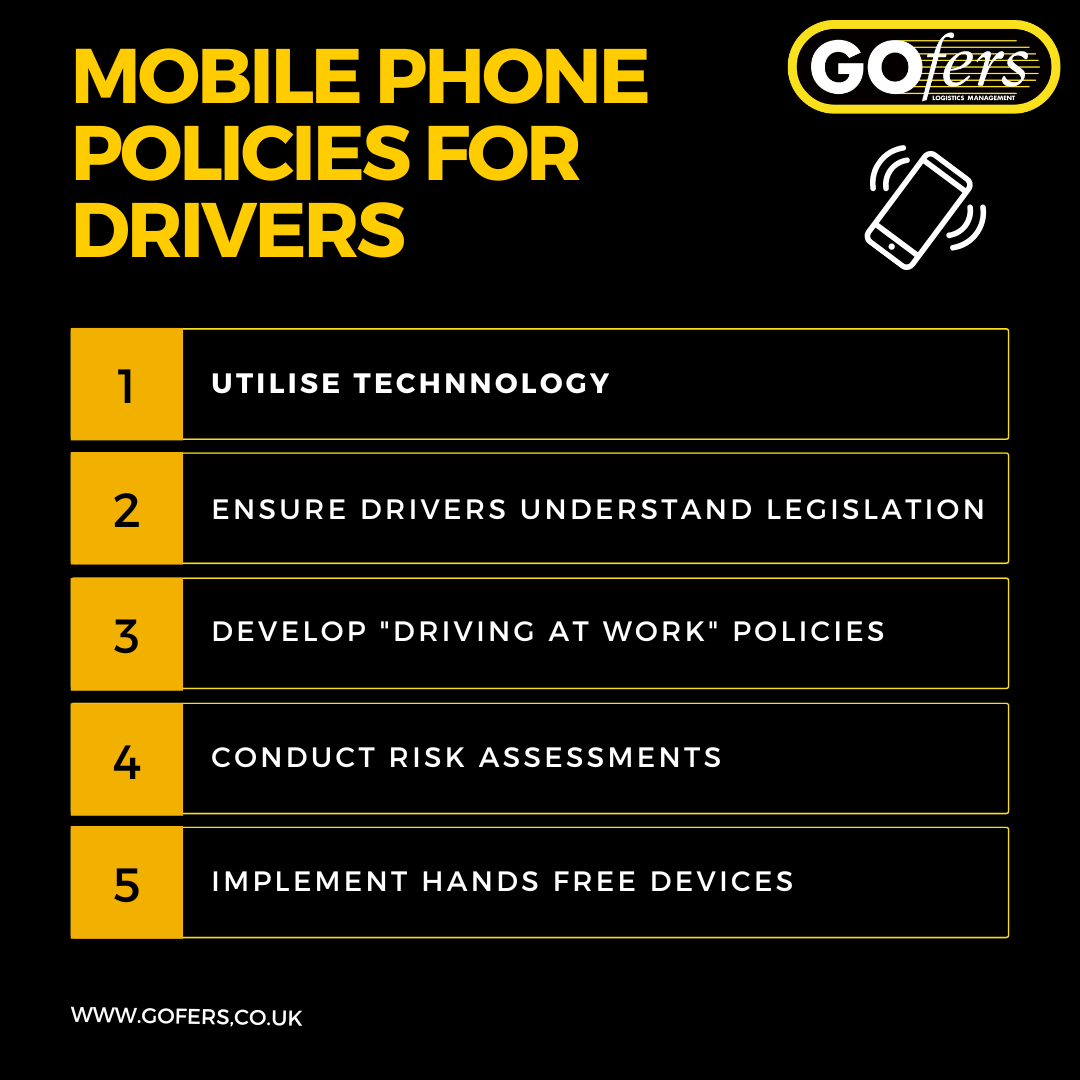
To ensure your business can still operate effectively alongside current and future mobile phone laws, you should abide by these steps:

Utilise Technology

Mobile phone use while driving remains an issue despite the recent changes to the law, which is why the Department of Transport (DfT) has long thought about introducing new technology to block mobile phone signals for drivers. The software would disable all functions on mobile devices that need an internet connection or a phone network connection, therefore rendering them worthless. Of course, this could lead to some major problems if a driver was to be in a crash and be unable to use their phone to call for help, hence why in part this has not yet been implemented.

With this in mind, it is crucial to promote the use of “Do Not Disturb” function on phones for all drivers, as well as Driving Mode, both of which effectively stop drivers using the phone when behind the wheel, but still allow for emergency calls if needed.

Ensure Drivers Understand the Legislation

You can lessen the possibility of a penalty by making sure your personnel are aware of the guidelines and what is expected of them. Unfortunately, a lot of drivers don’t know about the most recent laws around mobile phone usage, and believe that using a phone while stopped at a traffic light or in traffic is allowed.

Typically, an organisation where employees have to drive as part of their role should expect everyone in this capacity to drive safely for their own benefit and the benefit of others. This expectation should be understood by all workers, including senior managers and line managers. It should be clearly stated to employees that they cannot drive and use their phones.

Additionally, it’s crucial to make sure line managers are aware of the fact that they cannot expect their drivers to respond to calls or messages sent to them while they are on the road.

Develop a “Driving at Work” Policy

You can create your own “Driving at Work” policy, either as a stand-alone policy or as part of a larger “Driving for Work” policy and adjust it to meet the needs of your organisation. Ensure that the policy expressly prohibits anyone operating a mobile phone or other similar devices while driving, including in a company vehicle, their own vehicle, or a hired vehicle, from placing or receiving calls, sending or reading texts or emails, taking, sending, or viewing photos or videos, using apps, or browsing the internet.

Encourage drivers and their bosses to put their phones on voicemail, access messages during breaks, and only react to them then. To prevent the driver from being tempted to turn on or answer a ringing phone, phones should ideally be turned off and placed out of reach (such as in the glove compartment).

Conduct Suitable Risk Assessments

Health and safety law applies to on-the-road job activities, and hazards should be adequately controlled within a health and safety system, according to HSE’s “Driving at Work” Guidelines. Employers must therefore perform appropriate risk assessments and make sure that:

  • Work-related travel is safe
  • Employees are physically and mentally capable of driving safely
  • Vehicles are in good working order and safe to use

Implementing Hands-free Devices

You can reduce the likelihood that your personnel will violate the legislation against using a mobile phone while driving by adopting helpful measures to guide them and restrict the likelihood of mobile phone use. It could be beneficial to offer the following hands-free gadgets:

  • Bluetooth headsets
  • Dashboard holders
  • Voice command